8 Python ETL tools worth knowing in 2026
The right Python ETL stack depends on whether you need to move data, transform it, or operate the pipeline.
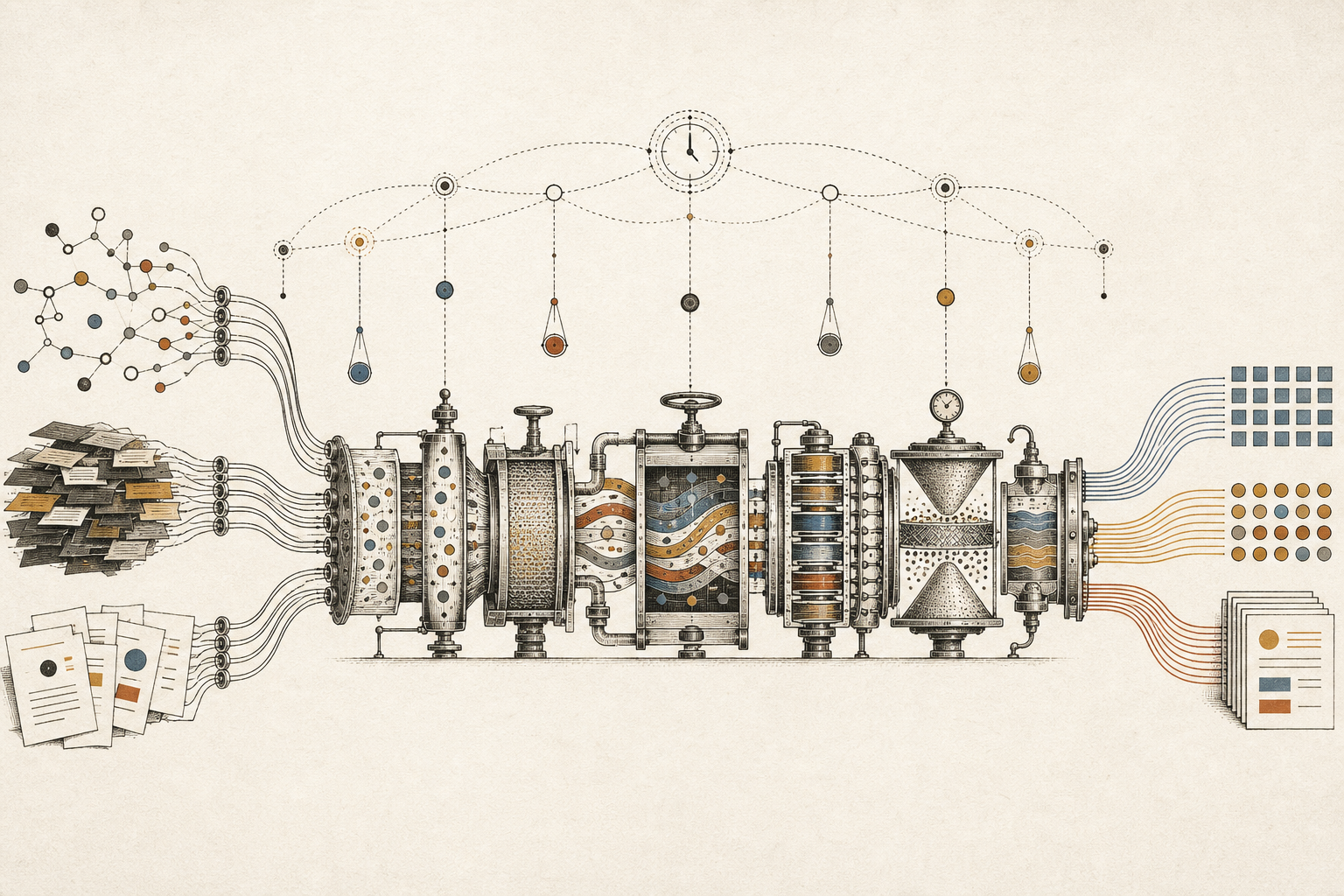
In 2020, a Python extract, transform, and load (ETL) stack often meant picking a library that could read a file, change some rows, and write a table. That is how I framed the first version of this article. Six years later, finding Python code that can move data is the easy part. The harder part is deciding which part of the pipeline each tool should own.
A production pipeline may need hundreds of source connectors, incremental loading, schema changes, distributed processing, retries, scheduling, lineage, and alerts. No library on this list is the best at all of those jobs. Some are transformation engines. Some move data. Some orchestrate work performed by other systems.
In 2026, choose the tool by the responsibility you need it to take over.
ETL now describes a stack
ETL means extracting data from one or more sources, transforming it into the required shape, and loading it into a target system. Extract, load, transform (ELT) reverses the last two steps by loading source data first and running transformations in a warehouse or lakehouse.
That distinction still matters, but most real systems contain both patterns. An application programming interface (API) response may be lightly cleaned before it is loaded. Business logic may then run in the warehouse. A Spark job may prepare a large dataset before another service publishes it. The pipeline crosses several execution environments even though people still call the whole thing ETL.
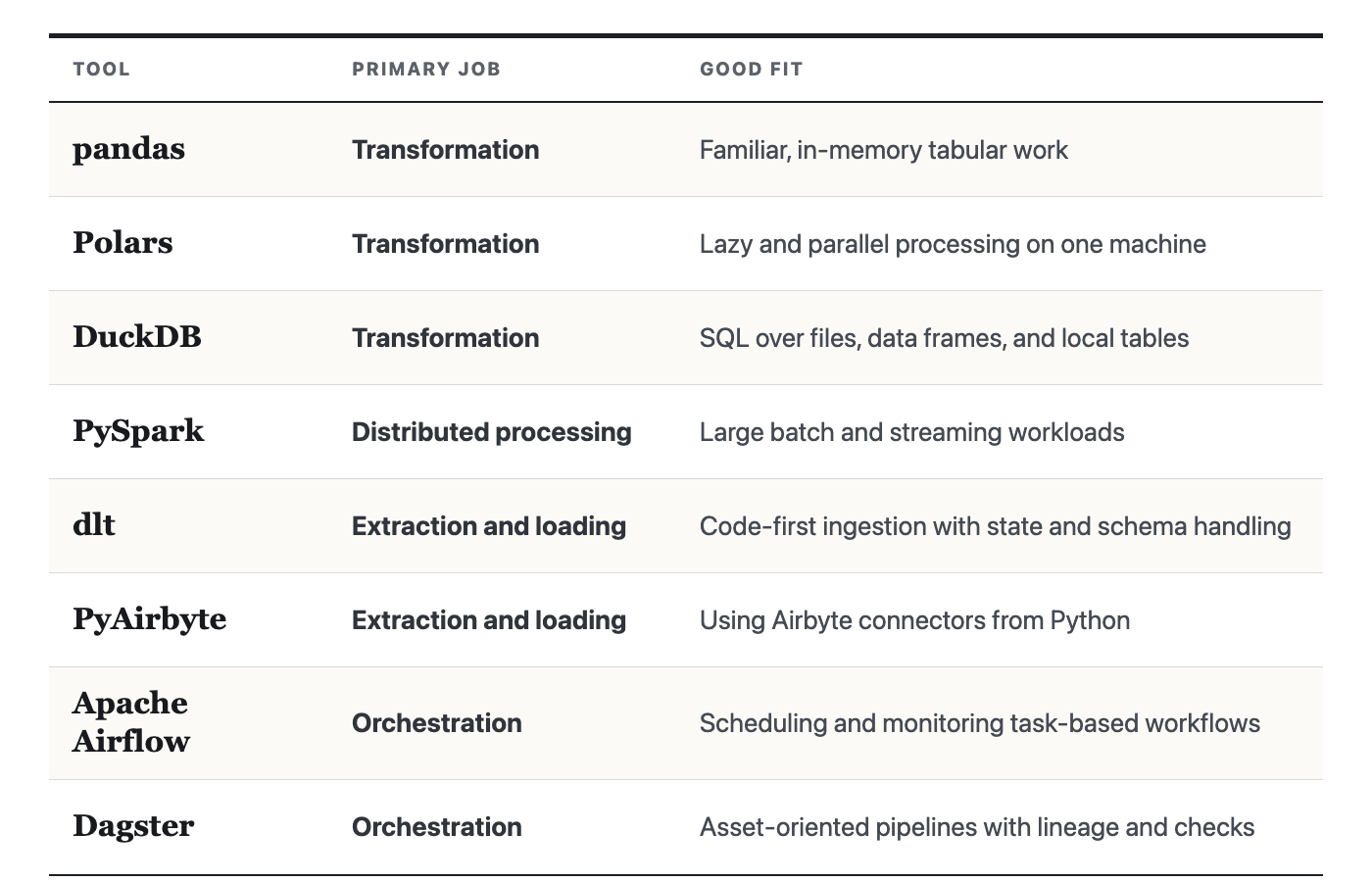
This is why the tools below are intentionally different from one another. The list covers four jobs: moving data, transforming it on one machine, processing it across a cluster, and operating the workflow in production.
1. pandas
pandas remains the easiest place to start for many Python developers. Its DataFrame is familiar, its input and output support covers common files and databases, and its transformation API can handle joins, filters, aggregations, reshaping, missing values, and type conversion.
pandas is a good fit when the data can be processed comfortably in memory and the pipeline does not need its transformation library to manage scheduling or distributed execution. It is especially useful for an existing Python application, a small recurring batch job, or a pipeline whose transformation logic is easier to express in Python than SQL.
Memory is the boundary to watch. The pandas documentation describes it as an in-memory analytics library and warns that even a sizable fraction of available memory can become unwieldy because some operations create intermediate copies. Chunking helps when each chunk can be processed independently. Once a job needs complicated operations across a dataset larger than memory, another engine is usually a better choice.
2. Polars
Polars provides a DataFrame API backed by a query engine written in Rust. It supports eager execution, where each operation runs immediately, and lazy execution, where Polars waits until the query is complete before planning the work.
The lazy API is the important ETL feature. Polars can push filters and column selection into the scan, which avoids reading rows and columns the job will discard later. Its streaming engine can also execute supported queries in batches rather than loading the complete result into memory at once.
Polars fits transformation-heavy batch jobs that still belong on one machine. Test it when a pandas job has become slow or memory-hungry but does not justify a Spark cluster. The tradeoff appears at library boundaries. If a downstream package accepts only a pandas DataFrame, the pipeline must convert the data at that point.
3. DuckDB
DuckDB is an embedded analytical database. It runs inside a Python process and can query CSV, JSON, and Parquet files directly. It also works with pandas, Polars, and Apache Arrow data without requiring a separate database server.
DuckDB is useful when the team prefers SQL or when the pipeline starts and ends with files in local or object storage. A job can scan a collection of Parquet files, join it to a local table, aggregate the result, and write another Parquet dataset without first importing every source into a long-running database.
It is still an execution engine rather than an orchestrator. DuckDB will run the SQL, but it will not decide when a daily job should start, retry a failed upstream API call, or alert the on-call engineer. Pair it with a scheduler or orchestrator when the job becomes operationally important.
4. PySpark
PySpark is the Python API for Apache Spark. It distributes processing across a cluster and supports Spark SQL, DataFrames, Structured Streaming, and machine learning pipelines.
PySpark belongs on the list because some ETL workloads genuinely need distributed execution. A pipeline may process many terabytes, join datasets that cannot fit on one machine, share a managed Spark platform with other teams, or use the same engine for batch and streaming work. In those cases, Spark provides an execution model that pandas, Polars, and an embedded database are not meant to replace.
The cost is operational and cognitive. Developers need to understand partitions, shuffles, serialization, cluster sizing, and the difference between code that runs on the driver and code that runs on workers. Small jobs can be slower and more expensive after cluster startup and distributed overhead are included. The Spark documentation recommends DataFrames over the lower-level resilient distributed dataset (RDD) API for most new work because DataFrames let Spark optimize the query plan.
5. dlt
dlt, which is short for data load tool, is a Python library for extracting and loading data. It accepts common Python data structures and can load them into databases, warehouses, lakehouse platforms, and filesystems.
dlt takes responsibility for the repetitive parts of ingestion. It can keep incremental state, infer and evolve schemas, create destination tables, map data types, and apply loading strategies such as append, replace, and merge. A developer can write a Python generator around an API and let dlt manage much of the destination-specific work.
This makes dlt a good fit when the source is custom or when the extraction logic belongs in application code. It does not remove the need to understand the source API, define keys correctly, or decide how schema changes should be handled. It also does not replace a transformation engine for complicated analytical logic.
6. PyAirbyte
PyAirbyte makes Airbyte source connectors available as a Python library. It can extract data from hundreds of sources and load the result into SQL caches such as DuckDB, Postgres, Snowflake, and BigQuery.
The connector catalog is the reason to consider it. Maintaining a custom connector for a software-as-a-service API means handling authentication, pagination, rate limits, incremental state, and upstream schema changes. PyAirbyte lets a Python pipeline reuse a connector that already implements much of that behavior.
PyAirbyte and the full Airbyte platform are different products. The PyAirbyte repository states that the library does not provide orchestration, scheduling, production alerting, or pipeline management. A team can prototype locally with PyAirbyte, place it inside another orchestrator, or move the connection to an Airbyte deployment later.
7. Apache Airflow
Apache Airflow is a workflow orchestrator. A workflow is represented as a directed acyclic graph (DAG) containing tasks and the dependencies between them. The scheduler decides when tasks run, workers execute them, and the user interface shows status and logs.
Airflow does not transform data by itself. An Airflow task can call a Python function, submit a Spark job, execute SQL, start a container, or trigger another service. That separation is useful because the transformation engine can change without forcing the team to replace the operational layer around it.
Airflow is mature and flexible, but it is a system that has to be deployed and maintained. Its scheduler, DAG processor, API server, metadata database, and workers create more infrastructure than a small pipeline needs. Managed Airflow services reduce that burden without changing the basic programming model.
8. Dagster
Dagster is also an orchestrator, but its central abstraction is a data asset. An asset can represent a table, dataset, file, or machine learning model. Dependencies between assets form lineage, and asset checks can test quality, freshness, or completeness.
This model is helpful when the team operates named data products rather than a collection of scripts. Instead of looking only at whether a task ran, an engineer can look at the table it produced, the upstream assets it depends on, its partitions, and the checks attached to it.
Dagster still needs deployment, storage, and operational ownership. Its asset model is also more opinionated than a simple task graph. That additional structure works well when lineage and data quality are central requirements. It may be unnecessary for a few independent cron jobs.
What changed since the 2020 list
The original version of this article included petl, pandas, Mara, Apache Airflow, PySpark, Bonobo, Luigi, and Odo. The six-year record is a useful reminder that software lists age unevenly.
pandas, Airflow, and PySpark remain clear choices. petl and Luigi are still maintained. petl remains a lightweight option for row-oriented table transformations, while Luigi still handles dependency resolution for batch jobs. An existing pipeline that works on either one does not need to be rewritten because newer tools exist.
The maintenance picture is weaker for the other projects. Mara Pipelines is an opinionated, single-machine framework built around PostgreSQL and command-line tools, and its repository shows less recent development than the main options above. Bonobo has not received a code commit since 2021 and still describes itself as a pre-1.0 project. Odo has not received a code commit since 2018. I would not start a new production pipeline with Bonobo or Odo in 2026.
Polars, DuckDB, dlt, PyAirbyte, and Dagster appear in the new list because they cover responsibilities that became much clearer over the past six years: optimized processing on one machine, SQL over files, stateful code-first loading, reusable connectors, and asset-oriented orchestration.
Choose from the bottleneck
Start with the part of the pipeline that is difficult to build or operate.
- If the data fits in memory and the team already knows the API, start with pandas.
- If DataFrame transformations are limited by speed or memory on one machine, test the real workload with Polars.
- If the work is SQL over Parquet, CSV, JSON, or local tables, try DuckDB.
- If the workload requires distributed batch processing or streaming, use PySpark.
- If custom Python extraction code needs reliable state, schema, and destination handling, use dlt.
- If source coverage is the problem and an Airbyte connector exists, use PyAirbyte.
- If the pipeline needs task-based scheduling and monitoring across several systems, compare Airflow.
- If the team wants to operate tables and datasets as assets with lineage and checks, compare Dagster.
A production pipeline can legitimately use several tools. PyAirbyte or dlt may move the data, DuckDB or Polars may transform it, and Airflow or Dagster may operate the workflow. Add each layer when the pipeline has the operating problem that layer solves.
Where this list stops
This list leaves out managed integration platforms, cloud-specific data services, and transformation tools centered on SQL rather than Python. Those products may be the better choice for a team that wants vendor-supported connectors, a visual interface, or transformations that run entirely inside a warehouse.
It also avoids universal performance rankings. File format, query shape, available memory, network throughput, destination behavior, and team experience can change the result. A benchmark on someone else's laptop should not decide a production architecture. Test the smallest plausible tool against representative data and the operations the pipeline will actually perform.
The 2026 Python ETL ecosystem is better because tools have become more specialized. Pick the smallest stack that takes responsibility for the hard part of your pipeline, then add another layer only when a real operating problem requires it.
About the author
Sean Knight is a serial entrepreneur in the San Francisco Bay Area who builds products and companies around AI and geospatial data. He began as an astrophysicist and moved into remote sensing, geospatial data science, and machine learning. Today he consults on AI and builds AI agents that run geospatial pipelines on platforms like Databricks. Find him on LinkedIn.